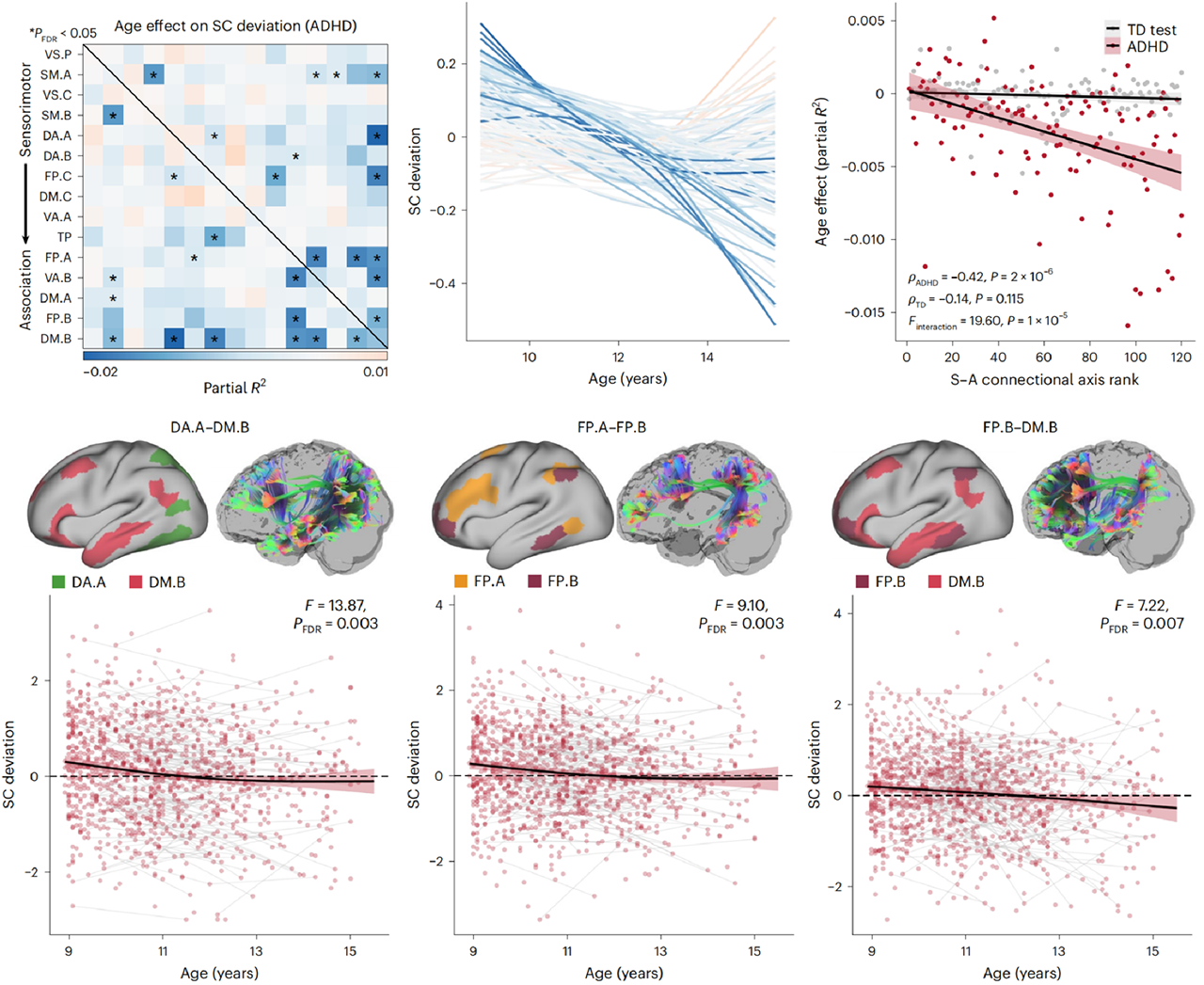
Our recent article in Nature Biomedical Engineering identifies developmental deviations in white-matter structural connectivity (SC) in youths with ADHD that track symptom trajectories and predict differential treatment response. Using normative modelling, we found delayed maturation and elevated deviations in association-network connections. A subset of these deviations declined with age. Deviations in frontoparietal–default mode connectivity further mediated age-related symptom improvement and tracked within-individual symptom changes. In a pharmacological treatment cohort, baseline SC deviations predicted response to atomoxetine but not methylphenidate, and SC deviations decreased after short-term pharmacological treatment. Together, these findings highlight individualized SC deviations as potential developmental markers for symptom monitoring and treatment stratification in ADHD.
This study was conducted in collaboration with Prof. Li Yang and Prof. Qingjiu Cao from Peking University Sixth Hospital. Congratulations to Xiaoyu Xu. We thank all collaborators who contributed to this study, especially Zhao Fu from Peking University Sixth Hospital, and Haoshu Xu, Jing Cong and Hang Yang from our lab.
Check here for more information: https://www.nature.com/articles/s41551-026-01779-4